It is the end of World War II and the beginning of the nuclear age. The American response to German rockets is a flurry of investments in missiles, rockets, and “pilotless aircraft” – all to deter a rising nuclear adversary, the Soviet Union. The introduction of the Air Force brings “main character” energy to US unmanned investments as Air Force General Curtis LeMay’s battle to shape his new service’s identity significantly alters the trajectory of unmanned for all the armed services. A Sputnik moment catalyzes investments in space even as President Eisenhower attempts to keep what he sees as dangerous armed service identity battles from hijacking the fragile peace in the domain. Meanwhile, as the US grapples with its new nuclear reality, unmanned strategic systems are front and center as tactical unmanned innovations in mines and early guided bombs debut in the Korean War.
ABOUT THE PODCAST
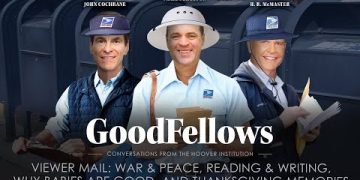
The Hand Behind Unmanned is a limited series podcast about the people who design, direct, and deploy America’s arsenal of unmanned weapons. The limited series podcast tells stories about their beliefs, identities, and the ways in which human ideas about warfare created and continue to shape today’s drone revolution. It is a history of US investment in mines, torpedoes, missiles, satellites, bombs, and drones from the point of view of the generals, admirals, career bureaucrats, academicians, politicians, and entrepreneurs that guided, dictated, and sometimes manipulated technology to create autonomous systems.
You can also pick up a copy of the book “The Hand Behind Unmanned: Origins of the US Autonomous Military Arsenal” by Jacquelyn Schneider and Julia Macdonald. Available now: https://www.hoover.org/research/hand-behind-unmanned-origins-us-autonomous-military-arsenal?utm_source=youtube&utm_medium=description&utm_campaign=thbu_description
__________
The opinions expressed on this channel are those of the authors and do not necessarily reflect the opinions of the Hoover Institution or Stanford University.
© 2025 by the Board of Trustees of Leland Stanford Junior University.
🔔 Subscribe for more discussions: @HooverInstitution
👍 Like and share this video!
🌐 Follow us on social media:
• Facebook: https://www.facebook.com/HooverInstStanford
• LinkedIn: https://www.linkedin.com/company/hoover-institution-at-stanford-university
• Instagram: https://instagram.com/hooverinstitution
• TikTok: https://www.tiktok.com/@hooverinstitution
• X: https://www.twitter.com/HooverInst