

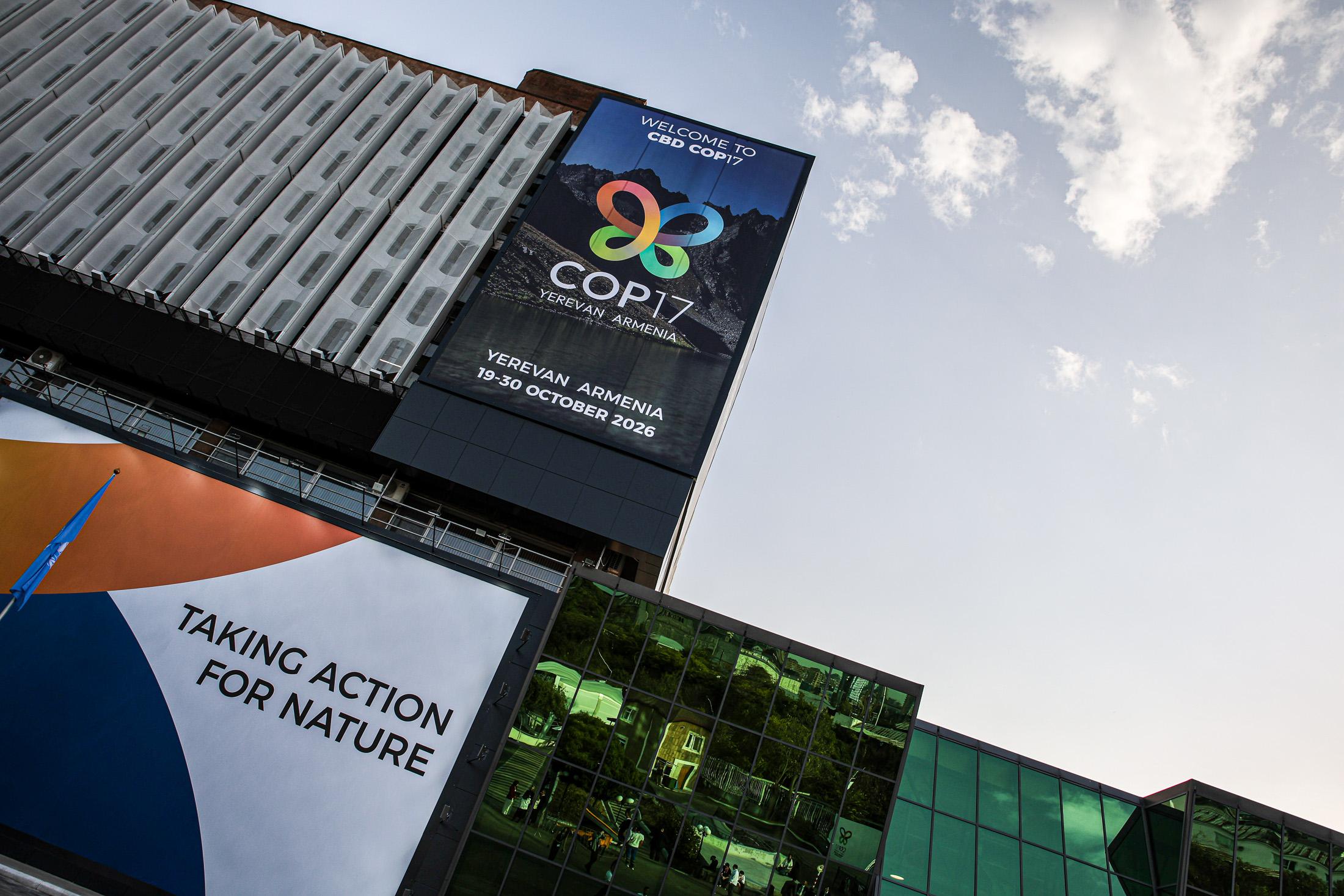
[YEREVAN, ARMENIA] Delegates from nearly 200 governments, United Nations bureaucrats, environmental NGOs, and assorted “stakeholders” are gathering in Yerevan, Armenia, this month for the 17th Conference of the Parties to the Convention on Biological Diversity with big plans for your life, liberty, and property. This writer, along with others in the CFACT delegation, have also arrived to bring you the straight facts about what they’re plotting to do.
Officially, COP17 is about “taking action for nature.” In reality, it is the latest chapter in a long-running effort to place vast tracts of land, water, and “genetic resources” under expanding international control, with national governments and private owners expected to fall in line. Also on the agenda is getting the UN-backed “biodiversity” agenda into all policy fields. The stakes could not be higher.
The UN’s 30×30 Land Agenda
The centerpiece is the first formal global review of the Kunming-Montreal Global Biodiversity Framework, adopted in 2022.  That agreement sets 23 targets for 2030.
The most explosive of those is Target 3: ensuring that at least 30 percent of the world’s terrestrial, inland water, and marine areas are “effectively conserved and managed” through protected areas and other measures. Yes, almost one third of the world’s surface area should be under UN and government influence if not control, with more to follow.
Supporters call it 30×30. Critics, including American agricultural officials who have examined parallel domestic efforts, have described similar schemes as a vehicle for locking up productive land and restricting the people who own and work it.
The framework sits squarely inside the broader UN Agenda 2030 Sustainable Development Goals, which former UN officials have openly described as the “masterplan for humanity” and the “declaration of interdependence.”
The biodiversity targets are meant to mesh with climate goals, land-use planning, subsidy reform, and financing rules. So-called “National Biodiversity Strategies” and “Action Plans” are the delivery mechanism for it all.
Governments and dictators are expected to revise them, report progress, and face a “stocktake” that identifies who is “behind.” Even governments that never ratified the Convention on Biological Diversity—the United States among them—face soft pressure through subnational governments, financial institutions, and the sheer weight of coordinated international policymaking.
Target 1 reinforces the point by calling for “participatory spatial planning across all areas” to “reduce biodiversity loss.” In practice, that language has repeatedly been used to justify burdensome controls and restrictions limiting what private landowners may do with their own property.
Target 14 takes the scheme even further. It calls on governments to ensure the “full integration of biodiversity and its multiple values into policies, regulations, planning and development processes,” among other areas. It also demands that public and private financial flows — read money — be aligned with the framework’s goals.
In other words, the UN’s biodiversity agenda is not merely about setting aside parks or protecting endangered species. It envisions embedding UN-backed environmental priorities into virtually every aspect of government policy, economic development, and financial decision-making.
From farming and housing to infrastructure and investment, the implications for private property, economic freedom, and national sovereignty are enormous. And the machinery to enforce compliance need not be controlled directly by the UN when national governments, regulators, banks, and corporations can do the job for it.
Private Property in the Crosshairs
Historical UN documents on “human settlements” have been remarkably candid on this subject. The Vancouver Declaration adopted at the 1976 UN Conference on Human Settlements (Habitat I), for instance, openly declared war on property ownership. “Land cannot be treated as an ordinary asset controlled by individuals,” it said. “Private land ownership is … a principal instrument of accumulation and concentration of wealth, therefore contributes to social injustice. Public control of land use is therefore indispensable.”
Compare that with the traditional understanding of property ownership. As recently as 2000, the Washington Supreme Court, citing longstanding American legal view, defined property like this: “Property in a thing consists not merely in its ownership and possession but in the unrestricted right of use, enjoyment and disposal. Anything which destroys any of these elements of property, to that extent destroys property itself. The substantial value of property lies in its use. If the right of use be denied, the value of the property is annihilated, and ownership is rendered a barren right.”
 Of course, contemporary “biodiversity” language is more polished than the brazen revelations in the Vancouver Declaration. But the operational effect — more government control and international influence over how land is used — remains consistent. American ranchers and farmers who watched the Biden-era 30×30 executive order understood the stakes, as seen in the national outcry. Unfortunately, its formal rescission has not eliminated the international template or the domestic constituencies still pushing related measures.
A $200 Billion Global Biodiversity Machine
The financial architecture is equally ambitious. Target 19 calls for mobilizing at least $200 billion per year for biodiversity from all sources by 2030, including major international funding from taxpayers in “developed” nations to compliant kleptocrats misruling “developing” countries. For perspective, that is more than the annual GDP of Arkansas or Nebraska, to be squandered by global bureaucrats on harmful regulations.
None of this requires a formal world government to constrain sovereignty. The mechanism is more subtle and, in some respects, more effective: a dense web of targets, reporting, peer pressure, financing conditions, and private-sector standards that increasingly ensnare national governments and property owners.
When “progress reports” circulating ahead of the upcoming summit claim the world is off track on the 23 targets, the prescribed response is, as always, faster and more vigorous “implementation” of the UN’s radical agenda. Leaders who gathered for a summit on the eve of the conference adopted a declaration calling for precisely that.
“The report shows that many of the critical elements of progress, including finance, capacity, cooperation and data, are still missing in action,” UN Secretary-General Antonio Guterres, former leader of the Socialist International, said about the State of Biodiversity Action report released in Yerevan. “Nature won’t thrive on good intentions.” He demanded more money and more UN-backed “biodiversity” concern injected into all policy areas.
The U.S. government officially remains outside the CBD agreement. However, the framework’s logic has already appeared in executive actions, state policies, corporate ESG commitments, and international financial institutions that American taxpayers ultimately help fund. Agricultural producers, energy developers, and ordinary landowners have the most immediate exposure. Broader economic costs arrive through subsidies, compliance burdens, and reduced productive capacity.
The pattern is familiar to anyone who has followed UN “climate” processes: an alleged environmental problem is identified and defined in global terms, national authority is portrayed as inadequate or even an obstacle to progress, and new layers of coordination and finance are presented as the only responsible path. Boisterous rent-a-mobs funded by governments (taxpayers) shriek and howl outside to make the looting in the summit seem more “moderate” and “responsible” by comparison.
COP17 will produce decisions, a “pathway” document, and renewed pledges. The practical question for sovereign nations and their citizens is how those outcomes will shape land-use rules, budgets, and property rights, all beyond democratic accountability or constitutional constraints. History suggests the danger is real — and growing. The remedy, as with other globalist and environmentalist UN schemes, is a renewed defense of national sovereignty, private property, and individual liberty.
The rights of the people who actually own and manage the resources in question are under assault. But the Trump administration and a growing list of allies have been taking a chainsaw to large swaths of the UN bureaucracy and agenda over the last two years. A turning point may finally be coming in the battle to determine who will make decisions: Self-governing sovereign nations and property owners, or the UN and its tyrannical allies. Nothing less than national sovereignty.
Images: UN / Earth Negotiations Bulletin, Public Domain
Go to Top
The post BIODIVERSITY COP17: UN deliberates in Armenia to Lock Up 30% of Earth’s Land and Water was first published by the Committee For A Constructive Tomorrow (CFACT), and is republished here with permission. Please support their efforts.