


When it comes to spending taxpayer dollars, promises are one thing. Results are another.
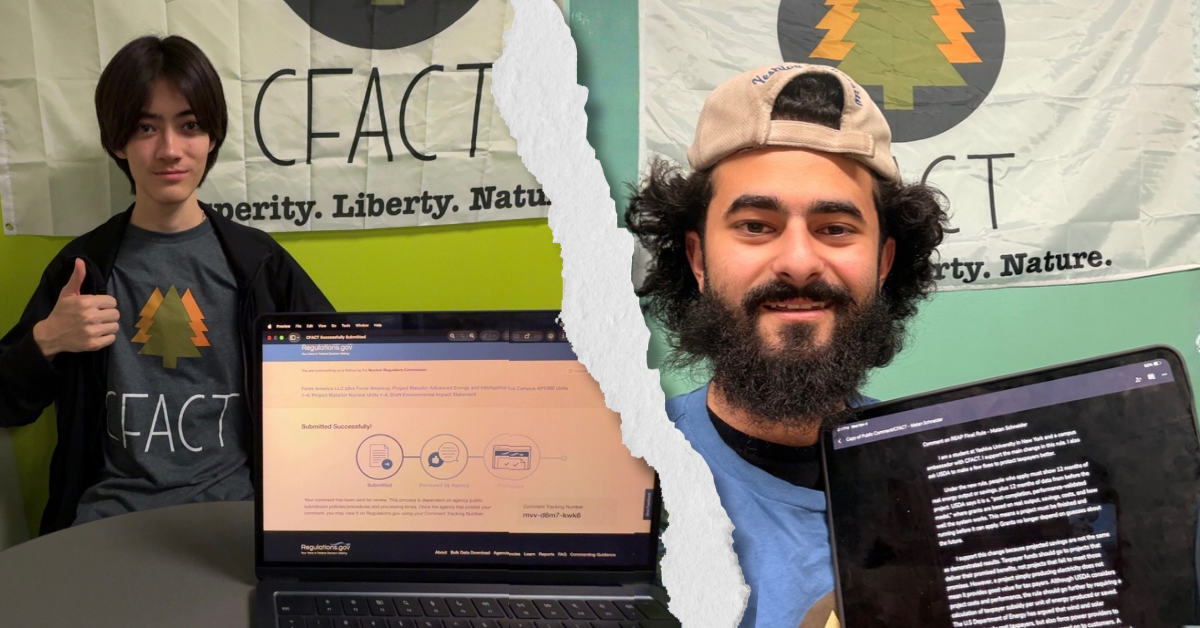
CFACT Collegian Matan Schneider of Yeshiva University in New York is calling on the U.S. Department of Agriculture (USDA) to make sure its rural energy grants deliver real results, not just projections on paper.
Matan recently submitted a public comment through Regulations.gov regarding changes to the Rural Energy for America Program (REAP), which provides federal grants to rural communities specifically for renewable energy projects.
Under the updated rule, the days of securing federal grants based on promises and projections are over. Applicants must now prove 12 months of actual energy production or savings data, along with a year’s worth of pre-project records, before applying for taxpayer-funded grants. In other words, projects must prove their worth before Uncle Sam opens his wallet.
Matan supports the shift toward performance-based grants but argues that the USDA should go further to protect taxpayers.
“Projected savings are not the same as demonstrated results,” Matan wrote. “Taxpayer funds should go to projects that deliver their promised benefits, not projects that fail to meet those promises.”
He also raised concerns about the broader costs of renewable energy, including backup generation. Citing a recent CFACT study on the economic costs of climate policy, Matan noted that Maryland residential electricity prices have reportedly increased approximately 44% since 2020.
“USDA should also examine whether rural energy stays affordable over time, not just one business’s bill,” he wrote.
Beyond energy affordability, Matan expressed concern that the new requirements could disadvantage smaller rural businesses.
Because applicants must now finance and complete projects before seeking reimbursement, businesses with limited financial resources may struggle to participate, even if their projects would otherwise qualify.
“Large corporations may handle that cost while a small rural business may not,” Matan explained.
“Rural taxpayers should not pay for projects that make us more energy-dependent on foreign supply chains,” he argued, highlighting how renewable energy technologies rely on other critical minerals processed overseas.
Matan sees the USDA’s new rule as a step in the right direction, but says there’s still work to be done. He says proving a project works is one thing. Proving it’s worth taxpayers’ money is another.
“Federal energy money should be evaluated by real results and real costs, not by promises of future savings,” Matan concluded. “This rule is a good step. With these changes, it can protect both taxpayers and rural communities better.”
Meanwhile, fellow CFACT Collegian Tyler Caldwell of the University of North Carolina at Charlotte is also weighing in on America’s energy future, this time advocating for the expansion of nuclear power.
Tyler submitted a public comment urging the Nuclear Regulatory Commission (NRC) to approve Fermi America’s proposed Project Matador Nuclear Units 1–4, which would bring four AP1000 nuclear reactors online.
“As America’s electricity demand continues to grow with advancements in artificial intelligence, data centers, and other emerging technologies, it is becoming increasingly clear that the United States needs dependable, affordable, and low-emission energy to remain economically competitive,” Tyler wrote.
Citing data from the U.S. Department of Energy, Tyler highlighted nuclear power’s 92.3% capacity factor, compared to 34.3% for wind and 23.4% for solar. Unlike renewable energy sources, nuclear facilities can generate electricity without checking the weather forecast before getting to work.
“Expanding nuclear energy is essential to securing America’s energy independence and building a reliable, resilient, and sustainable electricity infrastructure for future generations,” he concluded.
While Matan and Tyler addressed different energy policies, both Collegians are pushing for an energy future that prioritizes real-world results and American energy security.
Go to Top
The post CFACT Collegians Take Their Energy Concerns to Federal Agencies was first published by the Committee For A Constructive Tomorrow (CFACT), and is republished here with permission. Please support their efforts.