

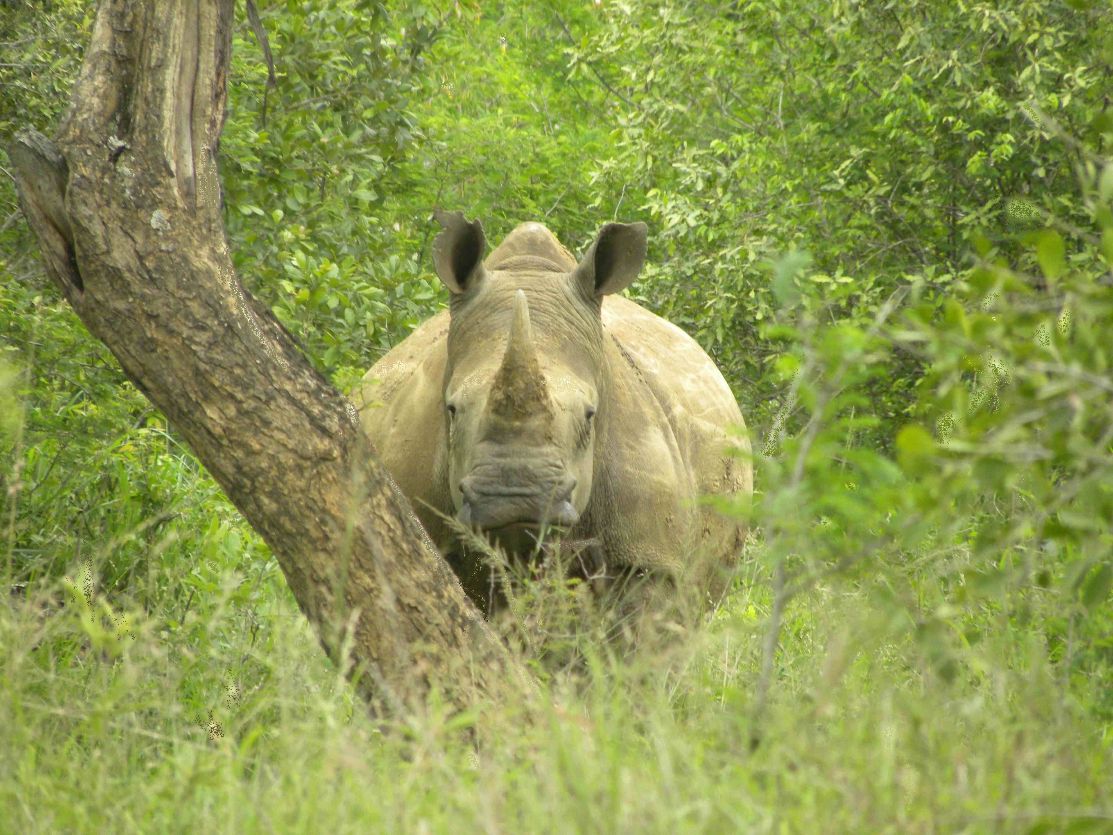
It is interesting to see how many extreme green organizations and individuals turn up as pro-Palestine supporters, and who one finds supporting the rioters in Paris. The truth of the matter is that virtually all of the extreme green organizations are actually political bodies seeking political power. They only use ‘the environment’ as the vehicle to rally support, and to give them a seemingly legitimate cause to pursue their real goals.
So these types of organizations are always ready to attack industry and any other organization who they see as ‘polluting’ or not doing enough for the environment. But do you ever see them really helping the environment? No, they only gripe about it. They are also very wealthy, with loads of income.

A female rhino has been darted by a veterinary team, with the objective of removing some of her eggs for fertilisation in the laboratory. The rhino has to be steered into the shade before the anaesthetic takes full effect and she collapses onto the ground, and can’t be moved.
Now for a case in point.
In South Africa rhino and elephant poaching continues to be a major problem. But do you think that green organizations would help. Not a chance. They want to rather attack some company for burning coal.
In the world-famous vast Kruger National Park conservation area, rhino poaching has increased considerably the past year, from 88 in 2024 to 175 in 2025. So the Park authorities approached the Electronic Warfare scientists at the Council for Scientific and Industrial Research (CSIR) in Pretoria.
The scientists developed and supplied a Phased Array Radar which scans the bush looking for poachers. It can detect something as small as a bird. It also detects if something as two legs or four, and then, using AI, decides if the two-leg variety is possibly a poacher. It then automatically sends a signal to a cell phone carried by an armed anti-poaching patrol.
The system was previously deployed in the Hluhluwe Game Reserve, some hundreds of kilometres away, and in a year the poaching was reduced from 198 in 2024 to 63 and 2025. This system is the Mark 2 version, since Mark 1 has been operational for some years. The system is quoted as having a range of 10 km but it is known to be more. But then legal issues come into play. The law controls how Game Patrols can arrest people, and who they can follow up.

Veterinarian Dr Morné de la Rey directs a veterinary student on how to find the ovaries of the female rhino. An electronic probe is used, and the image is projected onto the computer screen. The author was present, and the successful procedure took five hours.
All the illegal rhino horn and ivory then crosses the border illegally and makes its way to China and the far east where it is sold.
But are the greenies trying to stop this? No. They attack South Africa for talking of exporting horn and task legally, through a very controlled system. Every rhino and elephant has to eventually die naturally. Would it not be better to export that horn and tusk legally, through a very controlled system, rather than have the smuggled product going out of the back door?
The authorities here do not have enough money to deploy many radar systems. But there is no chance that the greenies will buy some systems with their millionso. They would rather organized a ‘save the Planet’ placard-waving march, or lobby the UN for trade bans.
Dr Jeanette Selier, a scientist at the South African National Biodiversity Institute (SANBI) points out that eco-tourism and hunting are both good for conservation. She explains that people go on a hunt for the excitement of the chase. In similar vein, tourists on a game drive do the same thing, but with cameras.
As a result, there are truly beautiful game lodges in South Africa which realize full well that they are selling an experience. Tourists marvel at the outdoor nature of these lodges, having dinner under the stars, while enjoying some of the best wine in the world, served by incredibly friendly waiters.
Frequently the dinners are held around a large fire, which is a very South African thing. Such experiences park themselves deep in one’s psyche, and stay there forever. It is an incredible experience to be out in the real wild, and to see elephants walk by. There is a deep spiritual thing which gets into one which is hard to explain to someone who has never experienced it.
Dr Selier goes on to explain how strictly controlled hunting is in South Africa. It is definitely not a free-for-all, shoot-anything-on-sight exercise, which greenie organizations frequently try to portray.
There are annual quotas set by the authorities. These quotas are determined by scientists. They monitor herd sizes and available food sources. They check movement pathways and patterns, and a myriad other factors. From all of this, very small hunting quotas are allocated each year. Permits are then issued. They are highly sought after. Then there are strict export controls on how parts of an animal can leave the country.
So the bottom line is that hunting benefits the protection and conservation of the animals. The legal routing of money through the system, to install radars, and fund skilled anti-poaching teams, is far better than the illegal backdoor trade of the poachers.
Photos Dr. Kelvin Kemm
Go to Top
The post Rhino poaching radar was first published by the Committee For A Constructive Tomorrow (CFACT), and is republished here with permission. Please support their efforts.