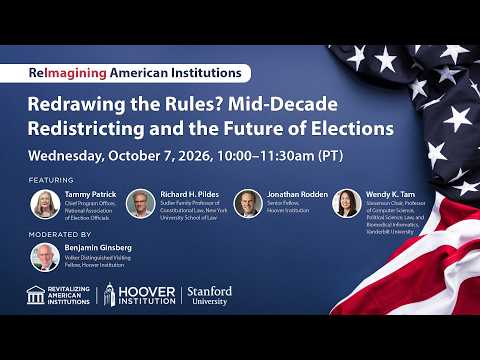
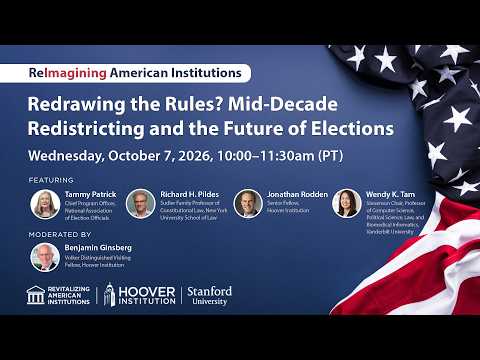
Redistricting is traditionally conducted once every ten years following the census, but in recent years some states have pursued efforts to redraw electoral maps in the middle of the decade. Supporters argue that mid-decade redistricting can correct flawed maps, respond to legal challenges, or better reflect population changes. Critics contend that it can be used as a partisan tool to entrench political power, reduce electoral competition, and undermine public confidence in democratic institutions.
Join leading scholars and practitioners for a timely discussion of one of the most consequential—and contested—issues shaping the future of American elections.
Interested in attending our next event? RSVP here: https://www.hoover.org/reimagining-american-institutions?utm_source=youtube&utm_medium=description&utm_campaign=event_youtube&utm_content=10112026
__________
🔔 Subscribe for more discussions: @HooverInstitution
👍 Like and share this video!
🌐 Follow us on social media:
• Facebook: https://www.facebook.com/HooverInstStanford
• LinkedIn: https://www.linkedin.com/company/hoover-institution-at-stanford-university
• Instagram: https://instagram.com/hooverinstitution
• TikTok: https://www.tiktok.com/@hooverinstitution
• X: https://www.twitter.com/HooverInst
The opinions expressed on this channel are those of the authors and do not necessarily reflect the opinions of the Hoover Institution or Stanford University.
© 2026 by the Board of Trustees of Leland Stanford Junior University.